
DHgate vs Alibaba:What’s the difference ? Key takeaways:
- Platform positioning: DHgate leans toward cross-border trading for small retailers and small-lot wholesale. Alibaba.com is a B2B wholesale platform for buyers worldwide — useful for ready stock, and often used to find factories, negotiate bulk orders and request customization.
- Minimum order quantity (MOQ): DHgate usually has a lower MOQ — sometimes you can order by the piece — which suits test orders and small restocks. Alibaba.com typically has a higher MOQ.
- Pricing style: On DHgate, listed prices are usually what you pay, with limited room to negotiate. On Alibaba.com, listed prices are often reference prices, with more room to negotiate.
- Customization: DHgate is mainly ready stock or light changes. Alibaba.com is a better fit for private-label packaging, spec changes and made-to-order production.
- Lead-time pace: Ready-stock orders on DHgate usually move from order to ship faster. On Alibaba.com, production orders — sampling, bulk production and ocean freight — often take clearly longer.
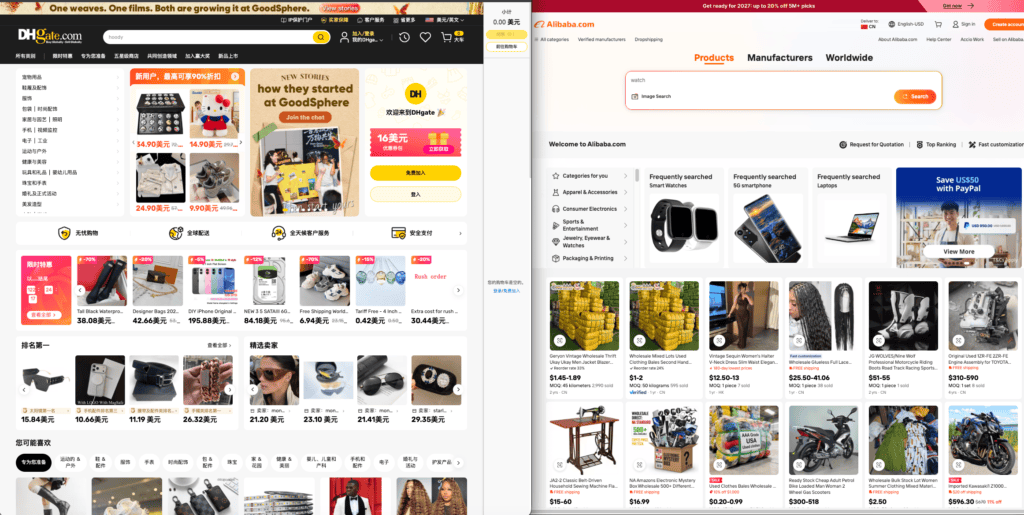
DHgate: Choose DHgate when you need a very low MOQ, small ready-stock lots and a fast way to check look-and-feel or market feedback — and you can accept a higher unit price and more quality variation.
Alibaba.com: Choose Alibaba.com when you want bulk buying, negotiation, OEM/private label, or you care more about supplier profiles.
Using DHgate and Alibaba together: In real sourcing, many buyers first use a small order to lock in style, packaging and basic quality, then move to Alibaba.com to negotiate bulk or customization. If you also want a clearer sense of domestic factory pricing, compare with 1688 vs Alibaba. If you’re buying machinery or industrial equipment, you can also compare with Made-in-China vs Alibaba.
Table of Contents
What Is DHgate?
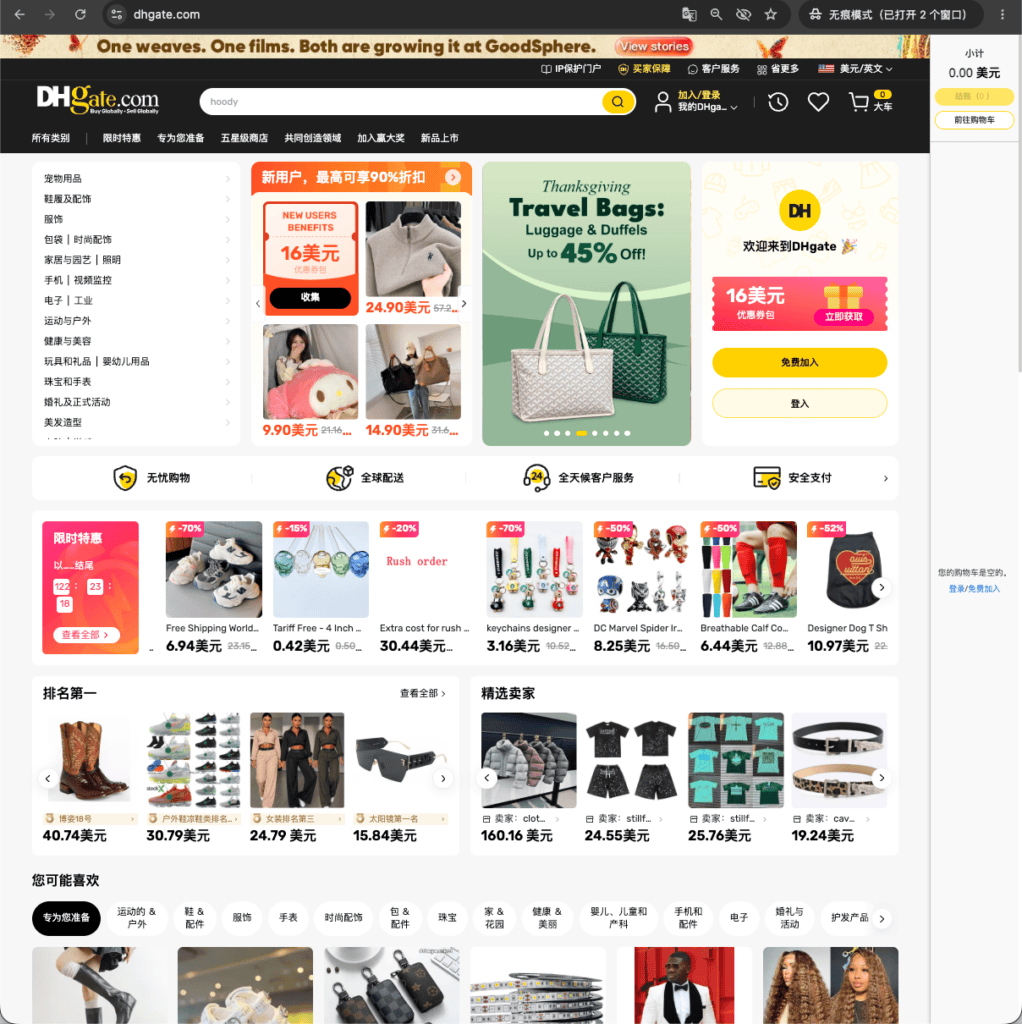
DHgate was founded in 2004. It is a cross-border B2B online trading and service platform for overseas buyers, focused on small retailers and small-lot wholesale. Most sellers offer ready stock or small-batch inventory with a low MOQ, so the platform is often used to test new SKUs or top up a little inventory. The platform offers escrow-style Buyer Protection. For more company background, see DHgate’s official About Us.
What Is Alibaba.com?
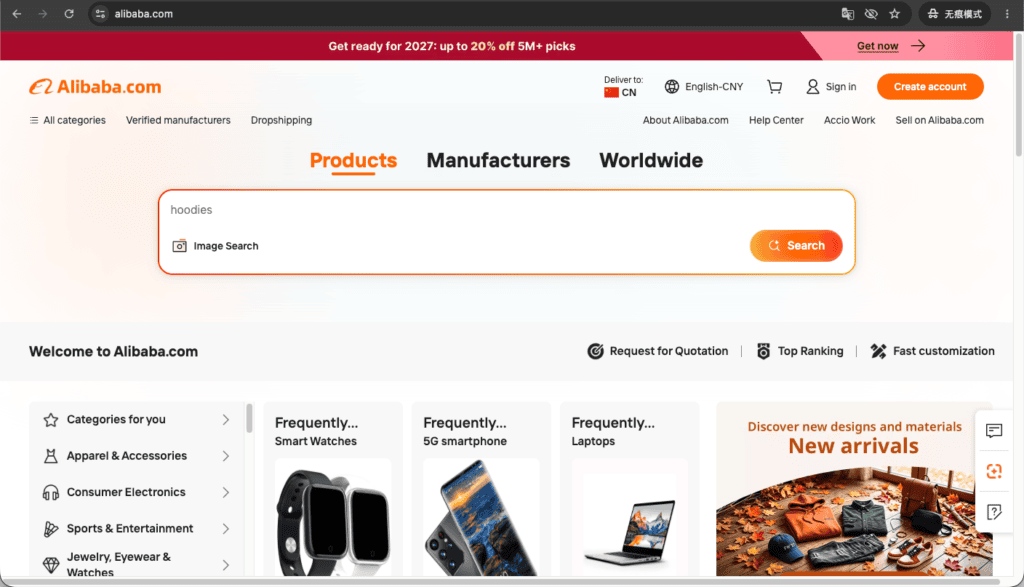
Alibaba.com is Alibaba Group’s all-category B2B wholesale platform for buyers worldwide. Don’t confuse it with other Alibaba Group sites: the platform for China’s domestic wholesale is 1688 — see the differences in 1688 vs Alibaba.
DHgate vs Alibaba: Similarities
- Both serve overseas buyers Both platforms are mainly English-facing and support cross-border orders and international shipping options.
- Both offer platform escrow-style protection As long as you pay inside the platform, funds usually aren’t released to the seller right away. Settlement follows the platform’s rules after you confirm receipt or at defined order milestones.
- Suppliers come from China’s supply chain On both platforms you’ll find everyday goods, parts, electronics accessories, home goods and other common categories. The same product can also show up on both platforms after a trading company resells it.
- Both can work for the early stage of cross-border sourcing The difference is whether they fit as a long-term main channel: DHgate is better for small-order validation; Alibaba.com is better for turning a validated product into stable supply.
- Both still require your own due diligence Reviews, years in business and badges are only a screening start. They don’t replace verifying the company entity, capacity and pre-shipment inspection.
DHgate vs Alibaba: Differences
| Feature | DHgate | Alibaba.com |
|---|---|---|
| Positioning | Cross-border small-lot wholesale / SME retail-oriented trading platform | Global B2B wholesale and factory-sourcing platform |
| Typical order type | Ready-stock small orders, test buys, small restocks | Bulk, RFQ negotiation, OEM/private label, ongoing supply |
| MOQ | Usually very low | Usually higher |
| Pricing & negotiation | Listed price first; limited negotiation | Listed price often a reference; more negotiation room |
| Customization / OEM | Limited; mostly ready stock or light changes | Private label, packaging changes, spec changes, deeper customization |
| Supplier types | Mostly small traders and wholesalers | Mix of factories, factory-traders and trading companies |
| Delivery & logistics | Parcel/express and small cross-border tickets; good for quick trials | Sample air freight plus bulk ocean / FCL; production orders take longer |
| Buyer protection | Buyer Protection / Escrow | Trade Assurance |
| Counterfeit / branded-goods risk | Branded knockoffs more common; higher risk | Risk exists too, but brand and verification investment is relatively more systematic |
| Best for | Test orders, small wholesale, budget-limited starters | Scaling up, customization, importers who want fuller transaction protection |
When Is DHgate the Better Choice?
- Testing a new product If you only want a few pieces first to see the physical product, shoot photos, try packing or run a trial sale, DHgate’s low MOQ is usually easier.
- Small restocks or short-cycle needs Accessories, freebies or standard everyday goods you’re already selling, when you only need a small top-up.
- Tight budget A low MOQ means less cash tied up. The trade-off is usually a higher unit price and fewer factory options.
- The category is already a small standard item For example common accessories, basic home small goods, unbranded white-label consumer products and similar.
When Is Alibaba the Better Choice?
- Bulk buying or preparing long-term reorders
- Private label, packaging changes or custom specs
- You care about Trade Assurance and public supplier profiles
- You care about platform maturity and protection
What Should You Watch for When Buying on DHgate / Alibaba?
Pay only through the platform — refuse off-platform transfers
Both platforms officially warn buyers: if a seller pushes you toward WeChat, a personal account, a Hong Kong account, or says “we can’t create an order on the platform — please wire us directly,” refuse and stay inside platform payment. DHgate clearly states that deals closed outside the platform make it hard to get platform help again (see its Buyer Protection notes). Alibaba.com also requires payment under platform rules for Trade Assurance to apply (see Trade Assurance and How Sourcing Works).
Sample or small order first, then scale
On DHgate, you can often buy one piece or a few pieces as a sample. On Alibaba.com, the more standard path is to pay for sampling first, confirm a golden sample, then place the bulk order.
Don’t stop at the listed price — calculate landed cost
Product page prices can look cheap. Add shipping, packaging, possible duties and local delivery, and at least have a mental landed-cost estimate before you order.
Branded goods and “too cheap” red flags
Treat obvious brand logos, luxury “same style” listings, or quotes far below common market sense with caution. Once counterfeits are seized by customs, platform after-sales help gets messy.
Badges and reviews are only a starting point
Alibaba labels such as Verified / Gold, and high star ratings on DHgate, mean the seller has an operating history or paid services on the platform. They don’t prove the product is high quality, or that the supplier’s real capability is solid. Before payment, we still recommend verifying the company entity and capacity, and arranging inspection before bulk shipment. See How to Verify Chinese Suppliers Are True Factories and Ways to Verify a Reliable Chinese Factory.
FAQ
Is DHgate better than Alibaba?
Neither is always better. DHgate fits low-MOQ small test orders and ready-stock small wholesale. Alibaba.com fits bulk buying, customization and formal sourcing where you want Trade Assurance.
DHgate or Alibaba for dropshipping / small wholesale?
If you’re only trial-selling in small volume or doing small-wholesale restocks, DHgate’s low MOQ is usually easier. If you’ve already decided to scale, need stable supply or want private label, we recommend Alibaba.com.
Is DHgate safe / legit?
The platform itself is a regularly operated cross-border trading site and offers escrow-style buyer protection. Real risk usually sits with the specific seller, counterfeit listings and off-platform payments.
Why is DHgate sometimes more expensive per unit?
Because you’re paying a premium for “low MOQ + ready-stock flexibility.”
DHgate vs Alibaba vs AliExpress — how do you tell them apart quickly?
DHgate: small-lot cross-border wholesale / test orders. Alibaba.com: B2B factory sourcing and bulk. AliExpress: more personal retail and small parcels.
Can I use DHgate to find a factory for private label?
We don’t recommend DHgate as your main channel for a long-term private-label factory. For private molds, tooling, stable capacity and factory-audit paths, prioritize Alibaba.com (or 1688), and verify the factory before bulk production.
Need a China Sourcing Agent?
Platforms help you see suppliers. What really decides whether the goods are good and leave on time is screening, negotiation, inspection and shipping execution. Once your orders move from test buys into bulk — or you need factory verification, pre-shipment QC, consolidation and customs documents — comparing prices on two websites often isn’t enough. If you want someone on the ground in China to handle supplier screening, verification, order follow-up and pre-shipment checks, contact us. As a China sourcing agent based in Shanghai, we can take your product and quantity and turn “which platform should I order on?” into “how does this shipment land safely.”