
China has one of the most complete manufacturing supply chains in the world, offering a wide range of products, competitive prices and strong production capacity. For overseas buyers, however, finding a Chinese factory is not the hard part. The real challenge is judging whether that factory is reliable. Many overseas buyers sourcing from China run into the same common importing problems: communication breaks down after the order is paid, deliveries are delayed, or the goods turn out to be poor quality on arrival. That is why, before you start working together and after you have confirmed the supplier is a real factory, verifying the factory’s reliability is an essential step in reducing sourcing risk. This article walks you through how to judge whether is a reliable Chinese factory , step by step, and lists the red flags and frequently asked questions.
Table of Contents
Step 1: Run an Online Background Check
Once you have confirmed that the supplier is a true factory, use online tools early in your communication to run a preliminary background check and get a rough picture of the factory’s real strength.
(1) Check the Company’s Business Registration
This is the most basic step. Search the supplier’s Chinese company name or its 18-digit Unified Social Credit Code (USCC) on the official National Enterprise Credit Information Publicity System, or with tools such as Qichacha. Be careful if you ask the factory for a photo of its business license: some irregular companies edit the image to disguise themselves. One of my clients in Mexico was once scammed exactly this way, so stay alert and cross-check the information through several sources. When reviewing the company information, focus on these points:
- Date of establishment: The longer a company has been in business, the more stable its operations and the more experience it usually has. If a company claims 10 years of experience but was registered only 2 years ago, that is a warning sign.
- Number of insured employees: Generally, the more employees with social insurance, the larger the factory. In China, however, it is not unusual for a small factory that has operated for over a decade and actually employs dozens of workers to pay social insurance for only a few of them. A low insured headcount does not necessarily mean the factory is unreliable; judge it together with what you see on site and its production capacity.Tip: If you find a company that has been established for over ten years, lists only three to five insured employees, yet has words like “production, manufacturing, processing” in its business scope, it is often an experienced small factory that is not good at online marketing and survives by supplying larger factories offline. Some of these factories are hidden sources of excellent suppliers.
- Risk information: Check for records of administrative penalties, labor arbitration and similar issues. These are all potential risk signals.
For products with high technical requirements, you can go further and check:
- High-tech enterprise certification: Look it up on China’s official High-Tech Enterprise Certification Management website. This certification involves a strict review and carries real weight, so it helps demonstrate the company’s R&D capability.
- Patents: Search China’s patent publication and announcement database, and distinguish between “invention patents” and “utility model patents”. Invention patents carry more weight and represent core technology. For official policy and information, see the China National Intellectual Property Administration (CNIPA) English site.
(2) Cross-Check on Baidu
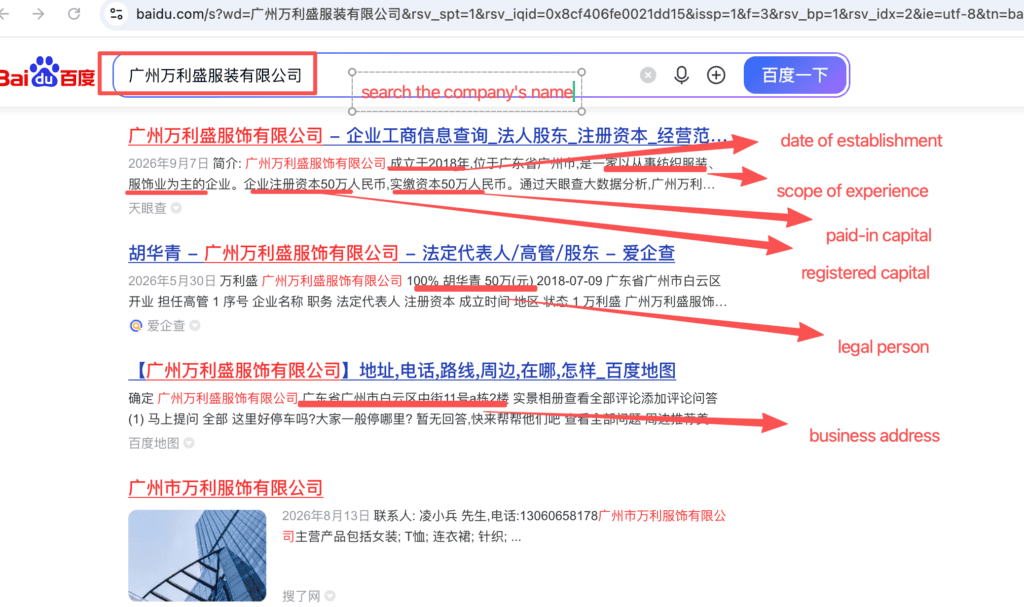
Search the supplier’s Chinese company name on Baidu and review any information that comes up about the company. Legitimate factories usually leave some footprint on the Chinese internet, even if it is just a simple Baidu Baike entry or a map listing. In general, searching a company name on Baidu brings up genuine basic company information such as its date of establishment, legal representative, company type, address and business scope. If the results are in Chinese and you can’t read them, take a screenshot and use Google Translate or an AI tool such as ChatGPT to translate and explain them.
Step 2: Assess the Factory’s Capability Through Communication
Communicating with the factory’s contact person is key to judging its professionalism and willingness to cooperate. A good supplier is not only about the factory’s hard capabilities; it is also about whether the factory is genuinely willing to work with you and patient and sincere enough to answer your questions and solve problems.
- Communication and responsiveness: Watch whether they truly understand your specifications, whether they proactively suggest processes or materials, whether they can turn vague requirements into workable parameters, and how deeply they understand the product itself. A manufacturer that communicates smoothly often saves you a great deal of time later and helps prevent many potential risks.
- Price traps: Price matters, but the lowest price is not necessarily the best choice, and don’t put blind faith in a “cost breakdown”. Be cautious when a factory’s quote is far too low; it may be one of the price traps that importers commonly fall into.
Step 3: Audit the Factory
If the order value is large or you hope to build a long-term partnership, a factory audit is an essential step. If you can, visit the factory in person. If you can’t travel, you can arrange a remote online audit or hire a professional team to inspect the factory on site. This is one of the most direct and important ways to verify whether is a reliable Chinese. During the audit, focus on the following:
(1) Online (Live Video) Audit
- The main gate and factory signage: does the name match the contracting company?
- Production lines in operation, work in progress and raw material areas
- Quality inspection area and defective product quarantine area
- Nameplates and general maintenance condition of the core equipment
- Shipping marks in the warehouse, packaging materials and goods waiting to ship
Ask them to follow the route you choose rather than just playing a fixed promotional video. If they only show you the office, or keep refusing any live factory view on the grounds of “confidentiality”, be on your guard.
(2) On-Site Audit
- Check the factory gate: Does the name on the gate and factory sign match the contracting company?
- Check workshop management: Is the site clean and orderly, are materials stored neatly, and do workers follow standard procedures? These details reflect the factory’s management level.
- Check equipment condition: Is the core equipment outdated, and are there maintenance records? This directly affects stable capacity and product quality.
- Check quality control: Is there a dedicated quarantine area for defective products, are there standard operating procedures (SOPs), and are there pre-shipment inspection records? All of these determine the product pass rate.
- Review past cases: Learn about the factory’s past projects, especially ones similar to your needs; they indirectly confirm its production capability.
- Gauge the team’s professionalism: Talk with the on-site engineers or production managers. This gives you a direct sense of the company’s expertise and management level.
Step 4: Make Sure Your Payment Is Safe
Before paying a deposit or a large amount, check:
- That the contracting party, the issuer of the proforma invoice (PI) and the bank account holder are the same legal entity (matching the Chinese company name on the USCC record and business license).
- Refuse any request to pay into a personal account or an unrelated company account, or to “temporarily switch accounts” for vague reasons.
- Any change to bank details must be confirmed again in writing and checked against the publicly registered entity.
What Are the Red Flags?
If you see any of the following signs, pause payment or step up your verification rather than letting it go on a verbal explanation:
- The business license image is blurry, its details don’t match the public record, or the supplier refuses to provide its full Chinese name and USCC.
- The years of experience they claim are far off from the registered date of establishment.
- The registration status is abnormal, the company is on the list of abnormal business operations, or it has unexplained administrative penalties.
- The quote is well below a reasonable range, and they can’t explain the materials, processes or margin behind it.
- They ask you to pay into a personal account, or the account holder doesn’t match the entity on the contract or PI.
- They only provide pre-recorded promotional videos and keep avoiding buyer-led live video tours or third-party audits.
- Their answers on key processes or the basis for their capacity are vague or contradictory.
- The sample doesn’t match the written specifications, yet they insist “mass production will be the same” and won’t put the change process in writing.
- Your contact person keeps changing, and no one can answer technical or lead-time questions.
- They pressure you to “pay in full or a large deposit today, or the price goes up / you lose your production slot”, while refusing to provide verifiable documents.
- The company name, address or scope on a certificate PDF doesn’t match the contracting entity.
- The factory gate sign or on-site signage clearly shows a different company from the one on the contract.
Frequently Asked Questions
How do I verify a reliable Chinese factory before paying?
Check the company’s registration and risk records using its Chinese name and USCC; assess the factory’s professionalism through communication; then confirm the site with a live video tour, an on-site visit or a third-party audit. Before paying, also make sure the contract, PI and bank account holder are the same legal entity.
What is the Unified Social Credit Code (USCC), and why does it matter?
The USCC is the 18-digit unique identifier of a Chinese company, essentially its “ID number”, and it is printed on the business license. Searching it in the national public records lets you confirm that the company really exists and that its status is normal, and reduces the risk of drawing conclusions from an image that may have been altered.
Is a live video factory tour enough, or do I need an on-site audit?
It depends on the order value, the level of customization and how long you plan to work together. For small orders and initial screening, a well-structured live video tour is often enough. For large orders, complex customization, or a factory that will be your main long-term supplier, an on-site visit or a professional audit is recommended.
What is the difference between verifying a “reliable” factory and a “true” factory?
Verifying a true factory answers “Is this company the actual manufacturer?” Verifying reliability answers “Can we work together long term on quality, lead times, communication and payment security?” We recommend completing the true factory verification first, then using this article to assess reliability.
What are the payment red flags?
The account holder doesn’t match the contract or PI, you are asked to pay into a personal account, the bank account is suddenly changed for unclear reasons, or you are pushed to pay a large amount in full before documents have been verified. If any of these happen, pause payment and verify the entity again.
Which official channels can I use to look up a Chinese company?
Company registration and credit information can be checked through the market regulation authorities, for example the State Administration for Market Regulation (SAMR). The publicity system’s domain is gsxt.gov.cn; it is often hard to access from outside China, so you may need someone in China to help. For patent and IP policy information, see the CNIPA English site. Third-party business databases are only supplementary; the final word is the government record cross-checked against the original documents.
Conclusion
Finding a Chinese factory is not difficult; the real challenge is finding one that is reliable, stable and suitable for a long-term partnership. MoodySourcing helps overseas buyers connect with quality Chinese manufacturers, providing supplier development, factory verification, product sourcing, quality control, production follow-up and international logistics coordination. Whether you need to source a single product or build a complete supply chain in China, feel free to contact us anytime!