
Made-in-China vs Alibaba: What’s the difference? Key takeaways:
- Positioning: Alibaba is a general B2B platform covering every category, serving small wholesale orders, samples and retail-style buying as well. Made-in-China is a B2B sourcing platform focused on the industrial, machinery and construction sectors.
- Scale: Alibaba is one of the largest B2B wholesale marketplaces in the world. Made-in-China is a smaller, more focused B2B platform for industrial goods.
- Product range: Alibaba covers every category. Made-in-China concentrates on machinery, equipment and industrial products.
- Supplier types: Alibaba has more trading companies. Made-in-China has a higher share of source factories.
- Payment protection: Alibaba offers the Trade Assurance payment protection program. Made-in-China offers Secured Trading Service, an escrow payment system, and customized products are usually not covered.
- Refund rules: Alibaba has a more mature after-sales system, a fast-track refund channel for small orders, an Easy Return local return channel, and stronger platform arbitration. Made-in-China’s refund rules are simpler and more conservative: customized products usually can’t be refunded, and the platform prefers that buyer and seller negotiate first.
So, Made-in-China vs Alibaba: which one should you use?
If you’re buying small items or everyday goods across many categories and need a huge selection and quick price comparison, go with Alibaba. If you’re buying industrial products, machinery or building materials, know exactly what you need and want a specialized source factory, go with Made-in-China. In practice, we recommend using both to cross-check: use Alibaba to get a feel for market prices and styles, then use Made-in-China to pin down experienced, specialized industrial factories.

Table of Contents
What Is Made-in-China.com?
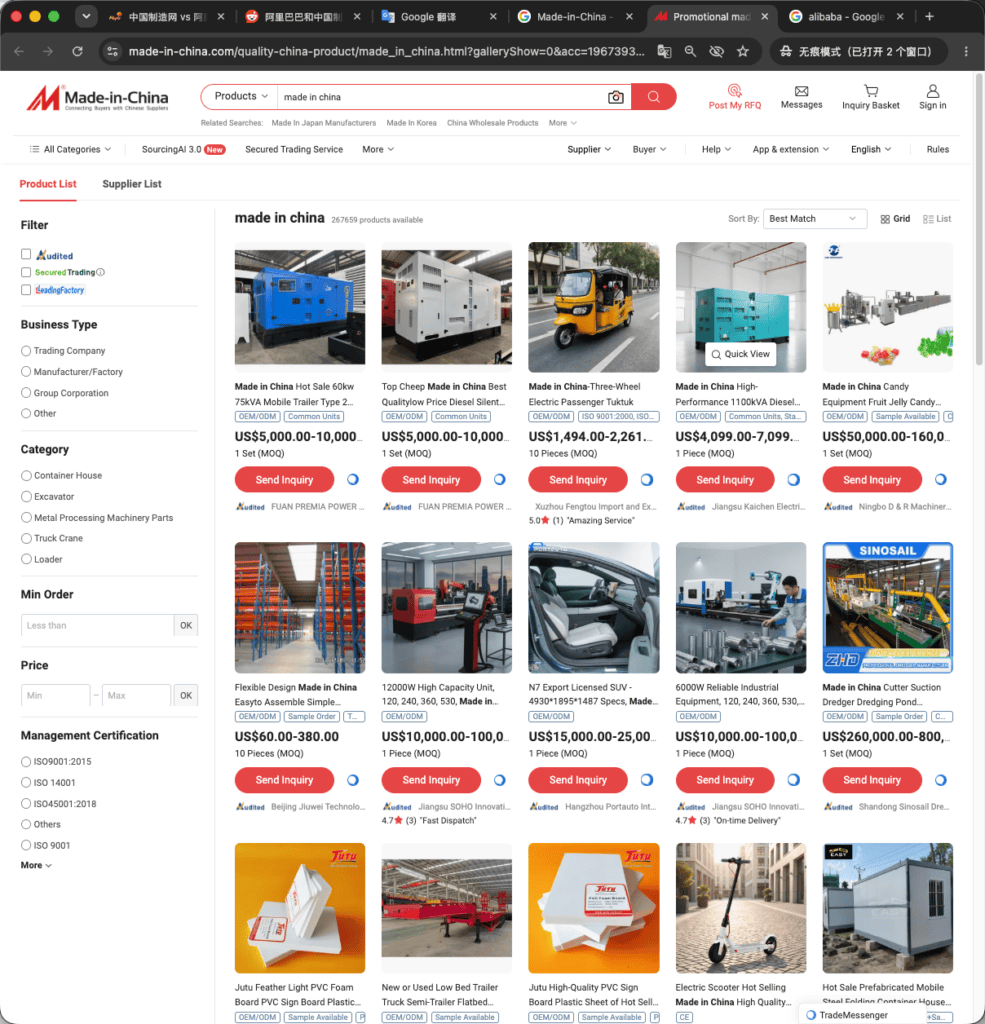
Made-in-China.com is a cross-border B2B sourcing platform focused on industrial products such as industrial equipment, machinery, hardware, agricultural machinery and building materials, connecting buyers worldwide with Chinese manufacturers and suppliers. Founded in 1998, it is developed and operated by Focus Technology Co., Ltd. What sets it apart: some suppliers have been audited on-site by third parties (SGS, BV, TÜV), most suppliers are source factories, and most buyers are professional purchasers. It suits buyers with clear sourcing needs who put supplier reliability first.
What Is Alibaba.com?
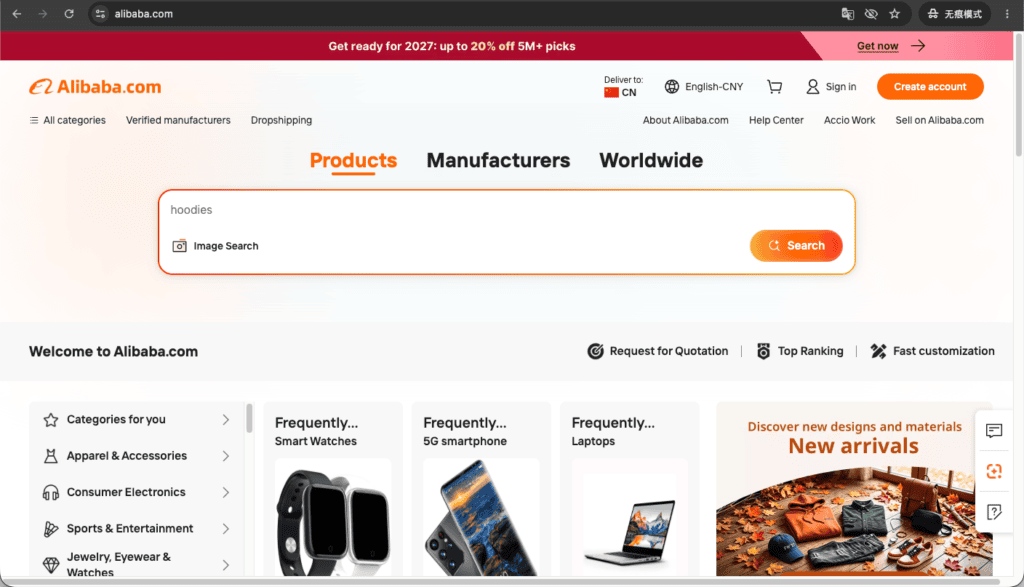
Alibaba.com is Alibaba Group’s all-category B2B wholesale platform for buyers worldwide. Source factories and trading companies are mixed together, which makes it a good fit when you want a huge selection and quick price comparison. Don’t confuse it with 1688, Alibaba’s platform for China’s domestic market. For the differences between the two, see 1688 vs Alibaba.
Made-in-China vs Alibaba: Similarities
- Platform type: Both are cross-border B2B (business-to-business) trade platforms for buyers worldwide.
- Both have factories and trading companies: On both platforms you’ll find source factories, factory-trader hybrids and pure trading companies, so you need to verify each supplier’s real identity yourself.
- Negotiable prices and customization: Prices shown on both platforms are reference prices; the larger your order, the lower the price. Most suppliers accept OEM or custom orders.
- Similar core features: Both offer product listings, catalog search, inquiries, online chat and RFQs.
- Both offer platform-secured transactions: On both platforms, your payment goes to the platform first and is released to the supplier only after you confirm receipt.
Made-in-China vs Alibaba: Differences
| Feature | Alibaba | Made-in-China |
|---|---|---|
| Positioning | General all-category B2B, also serving small wholesale, samples and retail-style buying | B2B sourcing focused on industrial, machinery and construction sectors |
| Scale | One of the largest B2B wholesale marketplaces in the world | Smaller, focused industrial B2B platform |
| Product range | Every category | Mainly machinery, equipment and industrial products |
| Supplier types | More trading companies | Higher share of source factories |
| Payment protection | Trade Assurance | Secured Trading Service (escrow); customized products usually not covered |
| Refund rules | More mature after-sales, fast-track refunds for small orders, Easy Return local returns, stronger platform arbitration | Simpler and more conservative; customized products usually can’t be refunded; platform prefers buyer and seller negotiate first |
Made-in-China vs Alibaba: Verification Badges
Many buyers see Audited Supplier, Verified Supplier or Gold Supplier and assume the supplier is reliable and a real factory. In fact, these badges are first and foremost services that suppliers pay for.
- Made-in-China’s Audited SupplierThis is an optional service for paying premium members, not a mandatory certification, and the supplier pays for it. Focus Technology’s 2025 annual report shows this audit service brought in about RMB 132 million that year. Audits are carried out by third parties such as SGS, Bureau Veritas and TÜV Rheinland, either on-site or as document reviews, and the platform can decide which method to use as needed. In other words, not every report comes from a visit to the factory.
- Alibaba’s Gold Supplier and Verified SupplierGold Supplier is Alibaba’s basic paid membership package and does not include a factory audit report on its own. Verified Supplier is a higher membership tier: a third-party inspection company verifies the supplier on-site and produces an assessment report that all buyers can see.
How to read an audit report: When you open a report, focus on these points:
- Company Type: The report states whether the company is a Manufacturer, a Trading Company or Combined (factory and trader). Plenty of companies in Made-in-China’s audit report listings are labeled Trading Company, so being audited doesn’t mean being a factory.
- Report date and type: Is it an initial audit (Initial) or a re-audit (Re-audit), and is the report a long time old?
- Audit method: Was it an on-site audit or a document review?
- Factory area, production lines, main equipment and capacity: Do these match the product you want to buy?
An audit report tells you that “this company passed a certain audit at a certain point in time.” It can’t guarantee the quality of your order. To judge whether a supplier is reliable, we recommend cross-checking in several ways, such as doing your own background checks and visiting the factory.
Is Made-in-China.com Legit?
The platform itself is legitimate. Made-in-China is operated by Focus Technology, a listed company, and has full rules for online transactions, escrow and dispute handling. The real risk is a supplier asking you to pay outside the platform. Common scam lines include: “We can’t create an order for this product on the platform,” “Pay us directly and we’ll give you a few percent off,” “Please pay our Hong Kong company account,” or “Pay our personal account via Wise.” Even if the supplier has an Audited Supplier or Diamond Member badge, once you pay into an account outside the platform, the platform’s transaction protection no longer covers that order. If something goes wrong, you’re left to deal with the supplier on your own. The same goes for Alibaba: its official page clearly warns buyers “do not pay outside the platform”, and wire transfers must go to the official receiving accounts provided by Alibaba.com.
Before you pay, verify the receiving account with the platform’s tool. If a supplier gives you a bank account and asks you to pay by wire transfer through Made-in-China, first log in to your buyer back office (Virtual Office), go to Transactions > Verify Account, enter the account number the supplier gave you and click Search. The system will show whether it’s an official platform receiving account. If it isn’t, don’t pay. After the wire transfer, you can also upload your remittance slip and track where the money goes under My Payments > View Trace.
Before you sign a contract and pay a supplier, we recommend checking whether the company is a real factory and whether it’s reliable. See How to Verify Chinese Suppliers Are True Factories and Ways to Verify a Reliable Chinese Factory.
Made-in-China vs Alibaba: Which One Should You Choose?
There’s no one-size-fits-all answer to Alibaba vs Made-in-China. It mainly depends on the type of product, your order size and your sourcing experience.
- By product typeFor standardized consumer goods and small items, Alibaba has more suppliers and faster inquiry replies, so comparing quotes is easier; we suggest starting with Alibaba. For machinery and industrial products, we recommend Made-in-China, because real factories make up a higher share of these suppliers on the platform and inquiry replies tend to be more targeted and professional.
- By order sizeFor small orders across many products, we recommend Alibaba, with its mature transaction and protection system. For medium to large, project-based or industrial-grade bulk orders, we recommend Made-in-China, where it’s easier to find specialized source manufacturers.
- By sourcing experienceIf you’re buying from China for the first time, we suggest starting with Alibaba, whose buying process is convenient and whose transaction and protection system is mature, and placing a small trial order. If you have sourcing experience and want to cut costs and find more high-quality source factories, you can compare prices across Alibaba, Made-in-China and China’s domestic 1688. Many good small and medium-sized factories only have a store on 1688. To learn more about 1688, see 1688 vs Alibaba.
In practice, we usually recommend using several wholesale platforms together. For example, search your product on Made-in-China, Alibaba, 1688 and other wholesale platforms, cross-compare prices, specifications and supplier credentials, and then decide which platform and which supplier to work with. At the same time, don’t rely too much on the platforms; you need to judge each supplier’s authenticity, reliability and capability yourself. Importing from China is a complex project with many risks, so when needed, we recommend working with a China sourcing agent to avoid common importing problems.
FAQ
Are Made-in-China and Alibaba the same company?
No. Made-in-China.com is operated by Focus Technology, and Alibaba.com belongs to Alibaba Group. They are two competing platforms.
Which is cheaper, Made-in-China or Alibaba?
There’s no fixed answer. Suppliers set their own prices on both platforms, and the same factory may quote differently on each. When you compare prices, compare them for the same specifications, quantity, packaging and trade terms.
Is Alibaba safer than Made-in-China?
Both platforms protect you in the same basic way: you pay through the platform and it holds the money in escrow. Alibaba has a longer refund window and a local return service for orders under USD 3,000; on Made-in-China, customized products can’t be refunded. For most buyers, safety depends more on whether you pay on the platform and whether you inspect the goods before shipment.
Can US buyers use Made-in-China?
Yes. When US buyers trade online on Made-in-China, the contracting party is Crov Inc., Focus Technology’s US subsidiary. Online transactions are currently not available in 29 countries and regions, including Cuba, Nicaragua and Venezuela.
How do I pay from Mexico?
Both platforms support local payment in Mexico. Made-in-China: SPEI costs USD 15 per payment and OXXO charges 2.99%. If you pay with a local method and then get a refund, some methods refund to an account you specify only 90 days after payment. Alibaba: SPEI costs the peso equivalent of USD 15 per payment, with a limit of USD 1 million per payment, and usually arrives within 1-2 hours; OXXO charges 3.5%, with a limit of MXN 9,999 (about USD 600) per payment, and only works for some order types, so large orders basically have to use SPEI or wire transfer. Neither SPEI nor OXXO payments can be charged back through your bank, so always pay at the platform’s checkout.
Finding a supplier on Alibaba or Made-in-China is only the first step in sourcing. Verifying the supplier, negotiating prices, checking samples, inspecting goods and arranging export shipping can each go wrong. If you don’t want to carry these risks alone, we’re happy to help. As a China sourcing agent based in Shanghai, we can verify platform suppliers for you, inspect goods at the factory before shipment, and support you through the whole process from order to delivery. Contact us and tell us what product you’re sourcing and in what quantity.